Table of Contents
If you’re running a fund or a fintech in the Netherlands and you’ve started looking at the UAE then you’ve probably come up against the same wall that everyone else does. Two names keep cropping up and every article will tell you both are excellent.
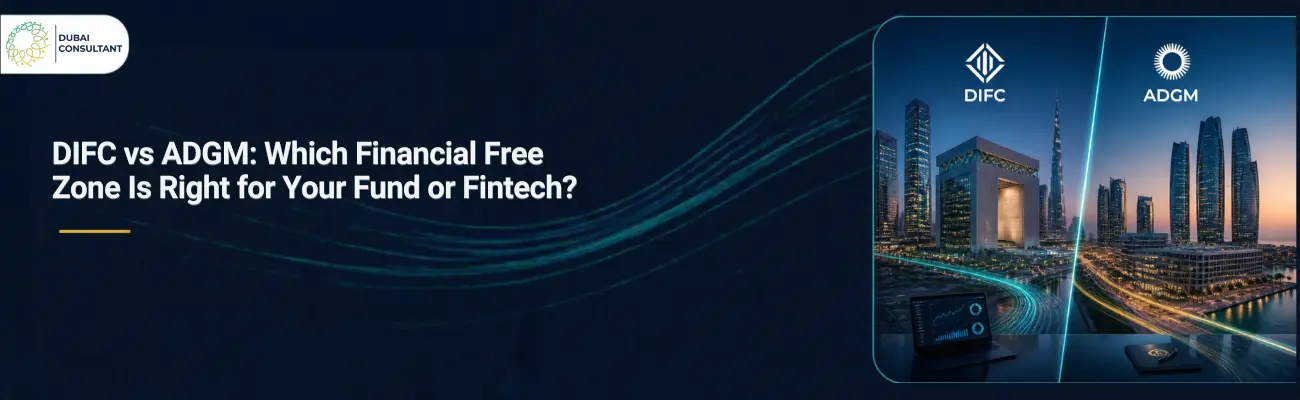
DIFC v ADGM isn’t really a question of which is the better jurisdiction. It’s a question of which one is appropriate for your business model, who your investors are and how much regulatory friction you can tolerate.
Quick answer: DIFC in Dubai is the bigger, more established hub with the deepest pool of banks, law firms and institutional clients. ADGM in Abu Dhabi applies English common law directly, is generally cheaper to set up and has a longer track record in relation to digital assets and Abu Dhabi capital. Both offer you a reputable regulator, English language courts and a route to 0% corporate tax on qualifying income.
The rest of the guide deals with the details that actually make the difference, with the Dutch side of the story being the one that most of the UAE-centric articles simply ignore.
Both are financial free zones. They are located within the UAE but each has its own regulator, its own court system and its own rulebook, separate from the rest of the UAE’s legal system.
The DIFC opened in 2004 and is regulated by the Dubai Financial Services Authority (DFSA). ADGM opened in 2015 on Al Maryah Island and is regulated by the Financial Services Regulatory Authority (FSRA).
If you don’t actually need a financial licence then you probably don’t need either one. A standard free zone company or a mainland setup is cheaper and quicker and our guide to the various types of business licences in Dubai will tell you which route is right for you. If you do need one then our team can go through the DIFC company setup and business setup in Abu Dhabi for ADGM.
Here’s the side by side. Treat it as a starting point as the fees and rules will vary from year to year.
| Emirate | Dubai | Abu Dhabi |
|---|---|---|
| Regulator | DFSA | FSRA |
| Legal basis | Own codified laws, with English common law as a supplement | English common law applied directly, plus ADGM regulations |
| Courts | DIFC Courts, English-language, common law approach | ADGM Courts, English-language, common law approach |
| Ecosystem | Largest cluster of banks, law firms, wealth managers and hedge funds in the region | Fast-growing, strong with asset managers, family offices and sovereign-linked capital |
| Fintech support | Innovation Licence and the FinTech Hive accelerator | RegLab regulatory sandbox |
| Digital assets | Established token regime | Longer track record, framework in place since 2018 |
| Cost posture | Generally higher | Generally lower, especially for holding vehicles and early-stage firms |
| Usually best for | Institutional managers and fintechs that want Dubai's banks and clients close by | Asset managers, digital asset businesses and holding structures |
Almost every comparison states that both zones are common law and that’s technically correct, albeit a little misleading.
ADGM applies English common law (including the rules of equity) directly pursuant to its Application of English Law Regulations 2015. Where an ADGM rule doesn’t cover the issue in question, English law provides the answer. DIFC on the other hand has its own codified statutes in respect of things like contracts, employment and companies and treats English common law as a mere background.
For a Dutch founder brought up on civil law that can sound rather academic. It doesn’t. If your fund docs and investor disputes are going to be based on English case law then ADGM is the more straightforward route. If your lawyers are the type who prefer clear written statutes then the DIFC approach can seem more predictable. Neither is right or wrong, they’re just different.
Both schemes allow you to operate collective investment funds under a DFSA or FSRA licence. Both also require real substance in the form of premises in the jurisdiction, qualified people actually on the ground and a compliance function which is not just a name on the register.
A few differences are worth noting.
DIFC gives you proximity. The fund administrators, the auditors, the banks and the law firms are all there and a number of the major global names have their regional offices based in the DIFC. If your investors are coming in from London or Amsterdam and you want them to be able to meet you in a proper financial hub then that’s going to be worth more than you can possibly imagine.
ADGM will often win on cost and on certain investor relationships. The base capital for the smaller managers is generally a bit lower. ADGM also announced revised commercial licence fees from 2025 (financial category at USD20k for new registrations and USD15k for renewals). Regulator fees are on top of that so always check the current schedule. The sovereign and institutional money in Abu Dhabi is also much more likely to be with ADGM which is an advantage if your strategy is one that’s aimed at Gulf anchor investors.
Tax is the same in both cases. A regulated fund manager who is a Qualifying Free Zone Person can get 0% on qualifying income as regulated fund and wealth management are on the list of qualifying activities as updated in 2025. Income that falls outside that list is taxed at 9%. It’s the regulation and the type of income that determines your rate, not the address. Our overview of the UAE tax changes in 2026 covers the wider rule changes and our guide to UAE corporate tax return filing covers what you’ll be filing once you’re up and running.
Funds can move between the two. There is a framework in place which links the UAE’s securities regulator with the DFSA and the FSRA enabling funds from either jurisdiction to be marketed to professional investors throughout the UAE. You don’t have to pick one jurisdiction and be excluded from the other’s home market.
Fintechs are a different ball game really as the right zone will be determined by what you actually build.
Teams in payments, lending, wealth tech and regtech that are selling to institutions tend to go for DIFC. The Innovation Licence, the FinTech Hive and the sheer number of banks all make it easier to get pilots going.
Crypto, tokenisation and the various other digital asset businesses are very much in the ADGM camp. Their regulator put out a virtual asset framework a number of years ago and has accumulated quite a bit of supervisory experience since. They also have the RegLab sandbox which allows early stage businesses to test a product under supervision prior to applying for a full licence. DIFC have their own token regime and their own sandbox route so it’s not all one way, but ADGM do have the advantage of having been there first.
One warning for Dutch founders. A DIFC or ADGM licence in no way gives you the right to serve customers in the EU. If you’re looking to onboard Dutch customers you’re still going to be subject to the AFM, DNB and for crypto the EU’s MiCA rules. Treat your UAE entity as your Gulf and global base rather than a way of getting around the European rules.
Regulators in both locations are very much interested in substance. You’ll need to be able to demonstrate the premises in the zone, people who can actually run the business and a compliance function with a named MLRO. Audited accounts are the norm as are ongoing AML controls and regular reporting.
Budget for that from day one. A thin setup that looks OK on paper is very likely to fall apart during review and can potentially put your 0% tax position at risk down the track. Good accounting and bookkeeping in Dubai from the very beginning is a huge saving in terms of pain later on. Our overview of the accounting and bookkeeping requirements for UAE companies will tell you what the regulators and auditors will be looking for.
If your fund is based in DIFC or ADGM and you’re looking to attract Dutch investors you’re a non-EU manager. As the rules have worked in recent years that would generally mean going down the Dutch private placement route. You notify the AFM, you include an attestation from your home regulator and you sell only to qualified investors. The AFM also require a cooperation arrangement with your regulator and your jurisdiction cannot be on the FATF list of non-cooperative jurisdictions.
Marketing rules are very strict and what constitutes marketing is broader than most managers realise. You absolutely must run your plan past a Dutch fund lawyer and check the AFM guidance before you speak to a single investor.
If you’re moving to Dubai or Abu Dhabi yourself then your personal position is going to be determined by tax residence and the Belastingdienst will look well beyond where you’ve just rented a flat. Our piece on tax residence and emigrating to Dubai goes through the criteria and our guide to the UAE 183 day rule for Dutch investors covers the day counting.
If you’re a Dutch resident and have the UAE company via a BV you’ll be asked about substance and whether the UAE company actually has any activity. A comparison of UAE corporate tax with Dutch tax will illustrate the difference in practice. For your own individual situation the best approach is to have a tax advisor in Dubai working in conjunction with your Dutch adviser.
A regulated firm still needs a bank to take it on and that can take longer than the licence itself. Our page on opening a bank account in Dubai will walk you through the process and our guide to the best banks in Dubai for Dutch entrepreneurs will compare the various options. If your team are still overseas you may also be interested in our article on how to open a bank account in Dubai without a residence visa.
No one can give you a single honest figure as regulated licensing is in layers. You pay a registration fee to the zone, a regulatory application fee and an annual supervision fee to either the DFSA or the FSRA. On top of that there’s the legal work, the audit, the compliance support and your own office. For a fund manager, the professional fees will almost invariably be greater than the government fees.
Timelines are much easier to predict. For a fund manager licence in either zone you can plan on somewhere between 4 and 6 months. That will of course be longer if your structure is complex or if the regulator has several rounds of questions. The sandbox route for early stage fintechs can be much quicker, though you’ll obviously add more time on to that if you then go on to get a full licence.
Ask every adviser for a written breakdown that splits the fees out into zone fees, regulator fees, third party adviser fees and running costs. If you’re given a single neat total then you need to ask what’s been omitted.
Residency is also part of the equation. Both zones will typically link their visa quotas to the size of your office and some founders will go the extra mile by pairing the arrangement with a Dubai investor visa or indeed the Dubai Golden Visa (for Dutch nationals). For the actual licence and visa paperwork we have our PRO services in Dubai which take a massive amount of the hassle out of it.
Choose DIFC if your business is reliant on proximity to Dubai’s banks, the counsel and institutional clients, if you’re a fan of codified law and if having that brand weight with European investors is important.
Choose ADGM if English common law applies directly to you, if you’re after a lower cost base, if digital assets are at the heart of your model or if Abu Dhabi capital is on your investor list.
And if neither of those options feels quite right then that tells you something as well. A holding company or an unregulated business might be better off with a standard free zone and our DMCC vs IFZA vs DAFZA comparison can help you make that decision. If you’re already operating a Dutch company and you’re looking at setting up a UAE arm then our article on branch office vs new company in the UAE will be of interest and our guide to Dubai company expansion for Dutch entrepreneurs will give you the full context.
Which is the cheaper jurisdiction, DIFC or ADGM?
ADGM is generally the more affordable option, particularly for vehicle holding and early stage companies. The cost differential can be eroded by regulatory fees, the cost of legal work and office costs so you need to get a full written breakdown from both jurisdictions prior to making your decision.
Is DIFC or ADGM better for fund managers?
Neither wins in any absolute sense. DIFC has the bigger network of banks, administrators and law firms. ADGM has English common law in application (i.e. directly), a generally lower cost base and closer links to Abu Dhabi capital. Both offer licensing of fund managers.
Do DIFC and ADGM companies pay 0% corporate tax?
Only on qualifying income. Both zones are free zones for UAE corporate tax purposes, but a company only comes to 0% as a Qualifying Free Zone Person where its income is derived from qualifying activities. Regulated fund management is one of those activities. All other income is subject to 9% tax.
Can a Dutch resident own a company in DIFC or ADGM?
Yes, foreign ownership is permitted in both zones. The more difficult issues are on the Dutch side (tax residence, substance and reporting). You’ll need to engage a Dutch tax adviser in conjunction with your UAE advisor.
Can I sell my UAE fund to investors in the Netherlands?
Possibly. As a non-EU manager you’d typically go down the Dutch private placement route (i.e. notify the AFM and only sell to qualified investors). The rules are subject to change so it’s worth checking with a Dutch fund lawyer first.
We work with Dutch founders and investors on precisely these sorts of decisions. A free business consultation is the quickest way to get you a costed comparison for your own structure or you can just get in touch with the basics and we’ll take it from there. You can also have a look at a number of the other guides on our Dubai business setup blog.
Pick the regulator you’re going to work with for the next ten years, because the address is the easy bit.

UAE Business Setup Experts
Dubai Consultant is a specialized business setup firm helping Dutch entrepreneurs establish companies in Dubai and the UAE. We offer end-to-end support for company formation, free zone licensing, corporate banking, and visa services, providing tailored solutions for clients from the Netherlands.
More about us →
Boulevard Plaza, Tower 2 – Office No. 1301, Burj Khalifa – Downtown Dubai, Dubai
Dubai Consultant © All Rights Reserved | Privacy Policy | Powered by InvesQ