Loading ...
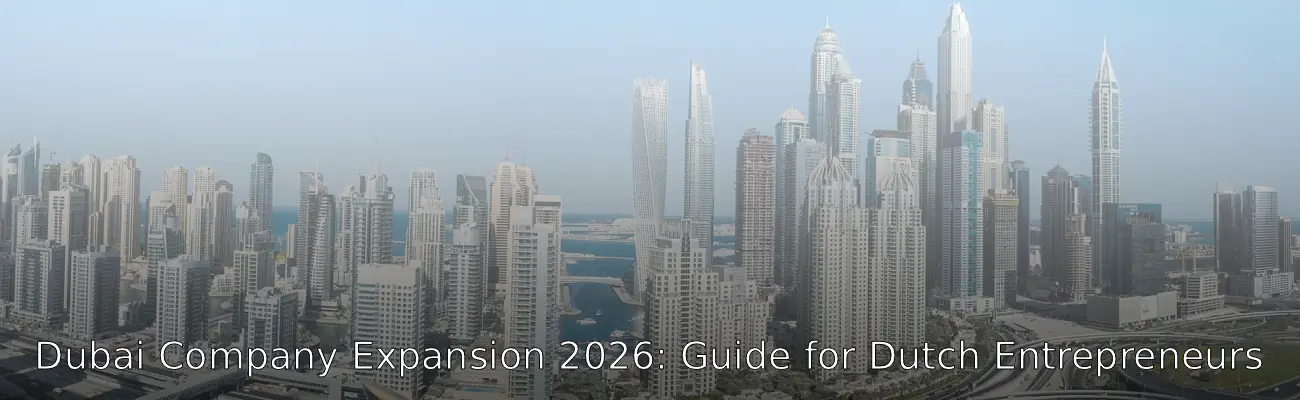
Dubai Company Expansion 2026 Guide for Dutch Entrepreneurs

How Dutch Entrepreneurs Can Expand Business to Dubai

You’ve built something solid in the Netherlands. Your Dutch business hums along nicely. But you’re asking the question that keeps many founders awake at night: What’s next?

Welcome to 2026. Dubai isn’t just another destination; it’s become the natural next move for thousands of Dutch entrepreneurs. And the reasons are more compelling than ever.

If you’re at that inflection point where expansion feels inevitable, this guide is built specifically for you. Not the beginner entrepreneur setting up their first company. You’re beyond that. You’re thinking about scaling operations, entering new markets, and building a regional hub connecting Europe to Asia and Africa. That takes a different playbook.

1. WHY DUTCH ENTREPRENEURS ARE CHOOSING DUBAI IN 2026

The Dutch-UAE Advantage You Might Not Know About

Let’s start with a fact that doesn’t get enough airtime: The bilateral trade between the Netherlands and the UAE has grown to over AED 11.5 billion in annual non-oil trade. That’s not a coincidence. That’s infrastructure.

The Dutch government recognized the opportunity, which is why the Dubai International Chamber opened its first office in the Netherlands just recently. This means Dutch entrepreneurs expanding to Dubai aren’t navigating in the dark anymore; there’s an institutional bridge already built.

But here’s what really matters for your expansion: The UAE-Netherlands Double Taxation Treaty protects your income. You won’t pay tax twice on the same revenue. That’s a structural advantage that makes the financial math work cleaner than it would in most other markets.

The 2026 Inflection Point

2026 isn’t arbitrary. This year marks the first real checkpoint for Dubai’s D33 economic agenda, a government-backed plan to double the city’s economy by 2033. What does that mean for you? Several bold initiatives are moving from planning to implementation:

  • AI adoption across government and business: The UAE government committed to becoming a top-10 AI economy by 2031. That’s capital flowing into tech infrastructure, talent recruitment, and innovation hubs.
  • New mega-infrastructure projects: Al Maktoum International Airport’s expansion will reshape aviation and logistics for decades. If your business depends on speed-to-market or logistics efficiency, this matters.
  • E-invoicing and digitization: The UAE completed the rollout of mandatory e-invoicing in October 2025. It sounds technical, but it means cleaner compliance, faster payments, and reduced friction for growing companies.
  • CEPA Network Expansion: The UAE’s Comprehensive Economic Partnership Agreements now cover economies representing over 2 billion consumers. For Dutch companies using Dubai as a hub, this translates to preferential tariff access across South Asia, Southeast Asia, and parts of Africa.

Translation: 2026 is when the infrastructure and policy clarity reach a critical mass. The window isn’t new, but it’s getting narrower before competitors realize it.

The Numbers That Matter

  • UAE Economic Growth: Projected 5% GDP growth in 2026, with the non-oil sector driving 5.3% growth
  • Non-Oil Sector Leadership: Technology, green energy, and healthcare are the top performers
  • Investment Confidence: 64% of UAE executives expect trade volumes to exceed 2025 levels
  • Setup Timeline: Company formation can be completed in as few as three business days (when done correctly)
  • Dutch Company Migration: Over 1,500 Dutch companies have established operations in Dubai in recent years, with the number accelerating.

These aren’t vanity metrics. They’re signals that the market is maturing, rules are clarifying, and competition for opportunities is intensifying.

2. THE EXPANSION PLAYBOOK: FROM DUTCH OPERATION TO REGIONAL HUB

Phase 1: Diagnosis – Is Your Company Ready to Expand?

Not every company should expand immediately. That’s the uncomfortable truth nobody likes to hear, but it saves founders from expensive mistakes.

Before you commit serious capital to Dubai expansion, ask yourself these questions:

Financial Readiness:

  • Do you have 6-12 months of operational runway reserved specifically for expansion costs? (Not hoping revenue covers it, actually reserved)
  • Is your quarterly revenue growth hitting 15-25% consistently? (This is the benchmark successful Dubai-scaling companies hit)
  • Have you achieved positive cash flow, or are you dependent on external funding?

Operational Readiness:

  • Can your current team handle scaling without collapsing? (This is where most founders get blindsided)
  • Do you have documented processes, or is everything in founders’ heads?
  • Is your product/service proven in your home market, or are you still iterating?

Market Readiness:

  • Have you identified specific customer segments in the Middle East, Asia, or Africa that your product serves?
  • Do you understand the competitive landscape in these regions?
  • Is there regulatory clarity around your industry in the UAE?

If you’re answering “sort of” or “not really,” you’re not ready yet. And that’s okay. Better to expand slowly than to spread yourself thin across continents while your core business falters.

Phase 2: Jurisdiction Selection – The Foundation Decision

This is where most expansion plans either thrive or get stuck in bureaucratic complications.

Mainland Setup (Direct Market Access)

  • Trade directly within the UAE market and serve government entities
  • 100% foreign ownership now allowed for most business activities (this changed in 2021, and many founders still don’t know)
  • Higher administrative overhead but unlimited market access
  • Best for: Consulting firms, B2B service providers, companies targeting local UAE revenue

Free Zone Setup (International Operations Hub)

  • 100% foreign ownership with significant tax exemptions
  • Simpler setup and lower compliance burden
  • Import/export duty exemptions
  • Over 40+ specialized free zones in Dubai (DMCC for commodities and trading, IFZA for tech and digital services, DAFZA for aerospace, DSO for logistics)
  • 100% profit repatriation (move money back to the Netherlands with minimal friction)
  • Best for: International trading companies, tech startups, logistics operations, holding companies

The Dutch Entrepreneur’s Decision Framework: If 60% or more of your target revenue comes from within the UAE, go Mainland. If you’re using Dubai as a hub to reach external markets (which is the case for most Dutch companies), a free zone makes more financial and operational sense.

If you’re leaning toward a free zone, you’ll want to understand how to navigate the specific free zone company registration requirements and explore options such as DMCC for trading companies or IFZA for tech ventures.

Your accountant can model the tax implications, but structurally, free zones give you more flexibility for scaling operations across multiple jurisdictions.

Phase 3: Smart Jurisdiction & Free Zone Pairing

Not all free zones are created equal. The biggest mistake scaling companies make is choosing a free zone based on cost alone, then discovering months later they picked the wrong jurisdiction for their business activity.

Industry-Specific Free Zone Recommendations:

IndustryBest Free ZoneWhy It Matters
Trading, commodities, precious metalsDMCCEcosystem of traders, direct market access, infrastructure for physical goods
Tech, digital services, softwareIFZA or DSOInnovation focus, faster approvals, talent availability
Logistics, supply chain, manufacturingJAFZA (Jebel Ali)Port access, mega-expansion underway, nearness to new mega-terminal
Financial servicesDIFCRegulatory clarity, international banking access, alignment with global standards
E-commerce, online retailDubai CommerCitySpecialized for online business, logistics integration
Design, media, creative servicesD3Design-focused ecosystem, startup support, talent clustering

The Inside Advantage: Sector-fit authorities (DIFC for finance, DMCC for trade, TECOM clusters for tech) don’t just issue licenses; they pair licensing with ecosystem support. Finance firms keep choosing DIFC because it’s not just paperwork; it’s access to international banking corridors. Trade companies scale in DMCC because the physical and business infrastructure is already there for that specific activity.

Don’t pick a free zone because your accountant suggested it or because it was cheaper. Pick it because your business activity has a natural home there.

3. OPERATIONAL SCALING: THE CHALLENGE NOBODY TALKS ABOUT

Talent Acquisition and Visa Strategy

Here’s where expansion plans hit reality: You need people, but acquiring and sponsoring talent in Dubai requires a strategic approach that’s different from the Netherlands hiring.

The Visa Landscape (2026 Reality):

Dubai has introduced flexible visa options designed specifically to attract global talent:

  • Employment visas (standard 2-3 year renewable)
  • Golden Visas (10-year renewable residence status for investors and specialists)
  • Sponsored family visas (once you’re established with a company)

The number of visas you can sponsor depends on:

  • Company structure (free zone vs. mainland)
  • Office size and location
  • Business activity classification

The Dutch Advantage in Talent Recruitment:

European founders hiring in Dubai often find that Dutch work ethics, technical expertise, and management practices are attractive to candidates from across the Gulf region. Your reputation as an employer from a stable, well-regulated market carries weight.

Understanding UAE residency visa requirements and how they align with your business structure is essential before hiring your first team members.

The Practical Timeline:

  • Month 1-2 (pre-arrival): Recruit management-level positions remotely
  • Month 3-4: Open office, establish visa sponsorship relationships
  • Month 4-6: Build initial team (typically 3-5 core roles for scaling startups)
  • Month 6-12: Scale to 8-15 people while refining hiring discipline

The Common Mistake:

Aggressive hiring in months 2-4 is one of the biggest mistakes founders make while scaling. You’re still learning the market, your team is still adjusting, and suddenly you’ve committed to salary obligations that outpace revenue. Hiring discipline in the early expansion phase matters more than headcount.

Technology Infrastructure and Digital Readiness

Your Dutch company runs on Dutch systems. Your Dubai expansion needs to run on integrated systems.

Critical Setup Checklist:

  1. Banking and Payment Processing
      • Open a corporate bank account (typically requires 3-5 business days with proper documentation)
      • Integrate payment processing for both AED (local) and multi-currency (for international clients)
      • Establish clear financial protocols between Netherlands and Dubai operations

    Once your company is licensed, the next critical step is opening a corporate bank account in Dubai, which typically takes 3-5 business days with proper documentation.

  2. E-Invoicing Compliance
    • UAE implemented mandatory e-invoicing in October 2025
    • Your financial software must comply (most modern systems do, but check)
    • Dutch operations may still use different invoicing standards; ensure compatibility
  3. CRM and Operational Systems
    • Centralize customer data, processes, and communication
    • AI-driven CRM tools are increasingly affordable and reduce manual work
    • This becomes critical as you scale from 2-3 people to 10+
  4. Regulatory Compliance and Accounting
    • You’ll need both a Dutch accountant (for your home market obligations) and a UAE accountant (for Emirates compliance)
    • The UAE’s corporate tax rate is 9% (with exemptions for free zone companies meeting certain criteria)
    • Work with specialists who understand both markets to avoid double-taxation pitfalls (though the tax treaty protects you)

4. MARKET PENETRATION STRATEGIES FOR 2026

Leverage the CEPA Advantage

The UAE’s Comprehensive Economic Partnership Agreements (CEPA) with major Asian, African, and South Asian markets are a structural advantage that most Dutch entrepreneurs don’t fully capitalize on.

Here’s what that means in practical terms:

CEPA-Enabled Market Access:

  • Preferential tariff access to markets representing over 2 billion consumers
  • Reduced import/export duties on goods passing through UAE hubs
  • Simplified customs procedures with partner countries

For Dutch Companies: If your product or service has any element of trading, logistics, or supply chain, or if you’re targeting customers across Asia or Africa, setting up in Dubai gives you preferential access that you wouldn’t get expanding directly from the Netherlands.

Real-World Application: A Dutch logistics or trading company expanding to Dubai can now access African markets through CEPA agreements that would have required separate market entry strategies before. That’s not just cost savings; that’s a structural competitive advantage.

Your business accounting and international tax planning should actively incorporate CEPA opportunities into your expansion strategy.

Sector Opportunities Aligned with 2026 Trends

Technology and AI Integration

  • The UAE government committed to becoming a top-10 AI economy by 2031
  • Capital flowing into AI infrastructure, talent, and innovation hubs
  • Opportunity: Tech consultants, software companies, data analytics firms

Green Energy and Sustainability

  • UAE investing heavily in renewable energy and sustainability initiatives
  • New subsidies and government contracts for clean-tech companies
  • Opportunity: Dutch cleantech companies have a strong reputation; this is a natural expansion vector

If you’re in the green energy space, exploring our guide on sustainable business opportunities in Dubai will help you identify specific funding and partnership avenues. Similarly, tech startup services in the free zones can accelerate your market entry.

E-Commerce and Digital Transformation

  • Dubai CommerCity is a specialized free zone for e-commerce
  • Regional e-commerce growth outpacing global averages
  • Opportunity: If you have a B2C product, Dubai is a gateway to explosive regional growth

Logistics and Supply Chain

  • Al Maktoum International Airport expansion
  • Jebel Ali Port is the world’s busiest container port
  • Etihad Rail expansion creating integrated logistics corridors
  • Opportunity: Logistics tech, supply chain optimization, last-mile delivery solutions

5. FUNDING AND CAPITAL STRATEGY

Realistic Funding Expectations for Expansion

Dubai’s funding ecosystem is maturing, but the dynamics are different from the Netherlands or European VC markets.

Estimated Expansion Costs (for a 2-5 person startup scaling to 8-15 people):

  • Initial setup and licensing: AED 10,000-50,000 (varies by free zone and jurisdiction)
  • Office setup and deposits (6-month lease + deposit): AED 30,000-150,000
  • Hiring and talent acquisition (salaries + recruitment): AED 200,000-600,000 (first 6 months)
  • Compliance, accounting, and legal services: AED 20,000-50,000 (ongoing)
  • Total First-Year Range: AED 260,000-850,000 (approximately EUR 70,000-230,000)

Funding Options in 2026:

  1. Venture Capital (if you’re a tech startup)
    • UAE tech funding reached $872 million in early 2025
    • Silicon Valley, European deeptech firms, and Asian tech conglomerates are all investing in Dubai
    • But funding is highly selective and sector-dependent
  2. Angel Investors and Family Offices
    • Ultra-high-net-worth individuals and family offices continue migrating to Dubai.
    • Opportunity for founders with proven traction
    • Often more flexible terms than institutional VC
  3. Bank Loans (traditional but underutilized)
    • UAE banks offer business expansion loans for established companies
    • Your Dutch credit history and business track record count for something
    • Typically requires 6-12 months of operating history in Dubai
  4. Strategic Partnerships and Revenue-Based Financing
    • Partner with larger regional companies for market entry support
    • Revenue-based financing is gaining traction as an alternative to equity dilution

The Dutch Founder Advantage: European founders often find that investors view them as lower-risk than founders from emerging markets. Your regulatory compliance background, financial transparency, and business practices are actually competitive advantages in fundraising conversations.

Profit Repatriation and Tax Planning

One of the biggest misconceptions: “Dubai is a tax haven, so I avoid all taxes.”

Reality is more nuanced, especially for Dutch entrepreneurs:

  • UAE Corporate Tax: 9% (with exemptions for free zone companies meeting certain criteria)
  • Personal Income Tax: 0%
  • Double Taxation Protection: The UAE-Netherlands treaty ensures you don’t pay corporate tax in both jurisdictions on the same income
  • Dividend Repatriation: From a free zone company, you can move profits back to the Netherlands with minimal friction

Practical Planning: Work with a tax advisor who understands both Dutch and UAE tax law (not just one or the other). The treaty protects you, but structure matters. Some founders save 20-30% of taxes through smart structuring; others accidentally create compliance nightmares.

6. POST-EXPANSION OPERATIONAL EXCELLENCE

Building Scalable Processes

This is where most scaling companies fail silently. Revenue grows, but quality drops. Customer satisfaction declines. Your team burns out.

Critical Processes to Document Before Scaling:

  1. Customer Acquisition and Sales – Can a new hire execute this without you?
  2. Service Delivery – Is quality consistent across team members, or dependent on your personal involvement?
  3. Financial Management – Can your operations finance person handle invoicing, reconciliation, and reporting across two markets?
  4. Compliance and Regulatory – Is your tax and legal compliance outsourced to professionals, or dependent on founder knowledge?

The Reality Check: If any of these processes require you personally to execute them, you can’t actually scale. You’ll just create a larger but more fragile operation.

Regional Expansion Strategy Post-Dubai

Once you’ve established a foothold in Dubai, the region opens up.

Why Dubai First: Dubai offers the fastest market entry, clearest regulations, and best infrastructure. It’s the jumping-off point for regional expansion.

Regional Expansion Timeline (Year 2-3 Post-Dubai):

  • Year 1 (Dubai Focus): Establish operations, build team, prove business model locally
  • Year 2: Test market entry into one adjacent market (Abu Dhabi, Saudi Arabia, or a CEPA partner country)
  • Year 3: Consider multi-country regional presence or master franchise/partnership models

Target Markets (Aligned with CEPA and Growth Trends):

  • Abu Dhabi (more conservative, government contracts, capital-intensive sectors)
  • Saudi Arabia (rapidly opening for foreign investment, massive growth in tech and logistics)
  • India and Southeast Asia (via CEPA access, high-growth consumer markets)
  • Africa (via CEPA, emerging middle class, growing e-commerce)

The point: Dubai isn’t the final destination for ambitious Dutch founders. It’s the first regional hub. Plan for that from year one.

7. REAL CHALLENGES AND HOW TO NAVIGATE THEM

Challenge 1: Regulatory Complexity (and How It’s Improving)

The Issue: UAE regulations are thorough, and missing a compliance deadline can complicate everything from visa renewals to license renewals.

The Reality Check: Most regulations are clearly published; the challenge is staying on top of them across two markets (Netherlands and UAE) simultaneously.

How to Navigate:

  • Hire a local compliance consultant from day one (not month 6)
  • Use project management tools to track compliance deadlines
  • Build 2-3 week buffers into deadline planning
  • Your accountant should be actively managing this, not just filing taxes

Challenge 2: Talent Acquisition in a Competitive Market

The Issue: Dubai’s talent pool is competitive. Salaries are higher than in many European markets. Competition is intense.

How to Navigate:

  • Offer non-salary benefits (visa sponsorship, career development, equity)
  • Build relationships with recruitment agencies early (don’t wait until you’re desperate)
  • Consider hiring across the UAE/Gulf region, not just Dubai (often underutilized markets)
  • For senior roles, recruiting European expats sometimes makes sense

Challenge 3: Market Saturation in Your Niche

The Issue: Depending on your industry, Dubai might already have 50 competitors doing what you want to do.

How to Navigate:

  • Choose your positioning carefully (don’t compete on price; compete on differentiation)
  • Leverage your Dutch reputation and European expertise as a moat
  • Target underserved adjacent segments
  • Plan for margin compression (things are often cheaper in Dubai than Europe)

Challenge 4: Managing Two Markets Simultaneously

The Issue: Your Netherlands operations can’t be ignored while you’re scaling Dubai. But you can’t be everywhere.

How to Navigate:

  • Delegate Netherlands operations to a trusted manager or partner by month 3
  • Implement clear communication protocols (weekly syncs, monthly reviews)
  • Use time zone differences strategically (Netherlands team works EU hours, Dubai team works ME hours)
  • Over-communicate; it’s cheaper than fixing misalignment later

8. 2026 SPECIFIC OPPORTUNITIES AND ACTIONS

D33 Economic Agenda: What It Means for Your Expansion

Dubai’s D33 agenda aims to double the economy by 2033. For Dutch entrepreneurs, this means:

Sector-Specific Support:

  • Tech startups: Innovation hubs, government support, capital availability
  • Green energy: Subsidies, government contracts, sustainability initiatives
  • Healthcare and biotech: Growing sector with supportive policies
  • Logistics and supply chain: Infrastructure investment, talent development

Action Item: Align your expansion around one of these priority sectors if possible. Government support (whether regulatory clarity or capital access) flows toward aligned ventures.

Infrastructure Projects Creating Opportunities

Al Maktoum International Airport Expansion:

  • New mega-terminal will increase Dubai’s aviation capacity significantly
  • Opportunity for: Logistics companies, cargo handlers, airport service providers, tech companies optimizing airport operations

Etihad Rail Expansion:

  • Rail corridor connecting Dubai, Abu Dhabi, and beyond
  • Opportunity for: Logistics firms, supply chain optimization, intermodal transport services

E-Invoicing Implementation:

  • Mandatory e-invoicing live since October 2025
  • Opportunity for: Accounting software companies, fintech firms, compliance automation vendors

Action Item: If your business touches any of these infrastructure areas, 2026 is when implementation accelerates, and contracts are awarded. Plan accordingly.

Visa and Residency Programs

Golden Visa Expansion:

  • 10-year renewable status for investors and specialists
  • More accessible in 2026 than previous years
  • Action: If you’re establishing long-term residency, explore golden visa options

Blue Residency and Free Zone Visa Packages:

  • Alternative residency pathways for talent attraction
  • Action: Include these in your talent acquisition pitch

Ready to expand your Dutch company to Dubai?

Our team of expansion specialists has guided 100+ Dutch entrepreneurs through this exact journey.

✓ No-Obligation Consultation | ✓ Strategic Business Setup Planning | ✓ Residency & Banking Assistance

✓ Expert Guidance at Every Stage | ✓ Dedicated Support Team

Schedule a free expansion consultation.


UAE Business Setup Experts

Dubai Consultant is a specialized business setup firm helping Dutch entrepreneurs establish companies in Dubai and the UAE. We offer end-to-end support for company formation, free zone licensing, corporate banking, and visa services, providing tailored solutions for clients from the Netherlands.